
 |
Fall 2000 |
Leech Prospecting in the Bolivian Andes
(Excerpts from Mark Siddall's diary)
|
 |
Date: October 25, 1999
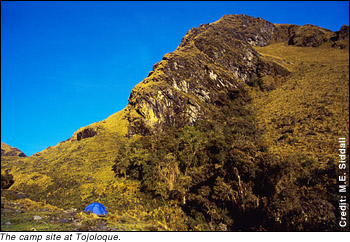
Location: Tojoloque, in my tent awake 45 minutes earlier than necessary. Altitude: A lot lower than it'll be in a few hours
4:48 a.m. As I stood outside facing north at the edge of the small cliff next to my tent, high up on my left the full moon had already ducked behind a high peak and cast an incandescent glow like a magnesium flare burning beyond the mountain tops. Its light cast shadows distorting shapes more familiar by day and lit up the south ridge I will climb in an hour. I'm going to take only the bare minimum for collecting leeches with me so as not to slow our pace.
5:13 p.m. I'd had a quick breakfast, gathered my stuff and left camp at about 6:05 am. The sun was only just peeking out from behind the mountains to the east. I asked Don Renaldo how long he thought it would take us to make the pass. Three hours was his estimate, then another hour from the pass to the lakes. All together a 4-hour hike. I was determined to prove him wrong since I needed more time for collecting.
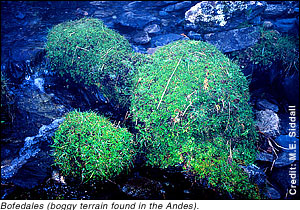 We
passed through the bofedales and arrived at the top plateau in good time.
Our next move was to carve our way up the side of the steep bowl lined
with sharp peaks and three passes. The pass we came in through five days
ago was to my right as I faced west. Our destination was the south pass
at a whopping 4430 meters. After a short break I forced myself to hyperventilate
and crammed a huge wad of coca in my cheek. I was ready.
We
passed through the bofedales and arrived at the top plateau in good time.
Our next move was to carve our way up the side of the steep bowl lined
with sharp peaks and three passes. The pass we came in through five days
ago was to my right as I faced west. Our destination was the south pass
at a whopping 4430 meters. After a short break I forced myself to hyperventilate
and crammed a huge wad of coca in my cheek. I was ready.
Don Renaldo led the slow back-and-forth switchback trail upwards. To hell with it, I thought. It'd take less time to go straight up. "Mas directamente," I said to Don Renaldo. "Si", was the response I got, and an "Arriba!" It took all of my strength and lung capacity to stay with him. We reached the high Incan Camino at about 3950 meters, where Don Renaldo turned and seemed pleased that I was still with him. With some satisfaction I crumpled to the ground. "Dos minutos, por favor," I implored. "Talves cinqo," he laughed. Yes, I thought, five would be lovely.
Along the Incan trail, which has a more gradual incline, suddenly Don Renaldo stopped in his tracks, crouched and motioned for me to do the same. Ahead were about a dozen viscacha, small mammals that look a bit like a cross between a rabbit and a squirrel. They'd heard us and bounded their way beyond the next ridge. "Rapido," he whispered, "pero tranquillo." As we quickly headed up to the ridge (trying not to breathe too loudly) I dug for my camera and set it to rapid fire. When we disturbed them again over the crest I fired off about six shots before they scattered once more.
We were nearing the pass and my pace was slowing steadily. I checked my watch. Ahead of schedule - good. One last push, my heart pounding so fast I could feel it against my sternum. Just as I thought my eyes were going to pop out of my skull or blood would spurt from my ears we arrived at the top.
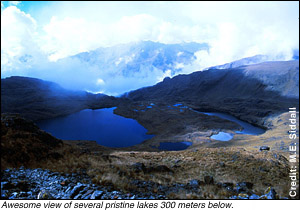
The pass itself was no more than a knife-edge positioned between two rocky peaks. The summits of these two couldn't have been more than another 15 or 20 meters. Down the other side, maybe 300 meters below, lay seven extraordinary blue and green lakes of varying sizes scattered across a plateau, each of them shining back at me, beckoning me in the still low morning light.
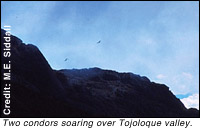
 We
sat on that sliver of rock, cushioned by moss and strange plants, and
looked out over the Tojoloque valley that we'd just scaled. A pair of
huge condors soared over our heads and continued northward. Shoot me now,
I thought. If I'm not in heaven, I'm awfully close. I knew that soon we'd
have to descend the loose shale down the other side, but the remaining
ten minutes reclining in the moss felt like an hour.
We
sat on that sliver of rock, cushioned by moss and strange plants, and
looked out over the Tojoloque valley that we'd just scaled. A pair of
huge condors soared over our heads and continued northward. Shoot me now,
I thought. If I'm not in heaven, I'm awfully close. I knew that soon we'd
have to descend the loose shale down the other side, but the remaining
ten minutes reclining in the moss felt like an hour.
 Well-rested,
we clinked and slid and otherwise worked our way down to Sietas Lagunas.
We were sampling the lakes by ten after nine. The first lake was more
of a pond, and after turning over about three or four dozen rocks to no
avail, I figured it was time to move on. Don Renaldo reasoned that the
pond was probably dry in the summer and thus unsuitable for leeches. We
decided to do a circuit of the valley, starting with the biggest lake
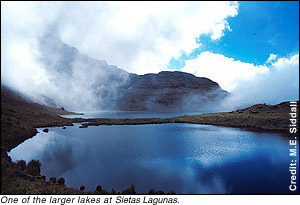
lying to the northeast. Though at 4100 meters it's large enough to sail
on, and with a cloud blowing in, it was hard to see the other side. As
we hiked towards it, there was a smaller lagoon that fed into the larger
lake by way of a short channel. We stopped to sample the lagoon, seeing
plenty of rocks, but these too were leechless. I was getting discouraged
and suggested we head straight for the lake.
Well-rested,
we clinked and slid and otherwise worked our way down to Sietas Lagunas.
We were sampling the lakes by ten after nine. The first lake was more
of a pond, and after turning over about three or four dozen rocks to no
avail, I figured it was time to move on. Don Renaldo reasoned that the
pond was probably dry in the summer and thus unsuitable for leeches. We
decided to do a circuit of the valley, starting with the biggest lake
lying to the northeast. Though at 4100 meters it's large enough to sail
on, and with a cloud blowing in, it was hard to see the other side. As
we hiked towards it, there was a smaller lagoon that fed into the larger
lake by way of a short channel. We stopped to sample the lagoon, seeing
plenty of rocks, but these too were leechless. I was getting discouraged
and suggested we head straight for the lake.
 Scientists
are a funny lot. We usually think practically and linearly. It's how we're
trained. We also tend to think suspiciously and agnostically. But, if
pressed, almost any biologist will tell you that every once in a while
you play your hunches, your gut, and it usually comes out right. I have
no idea why, but I decided to turn to my right as we passed the channel
and picked up a rock in the middle of the stream. There was nothing notable
about this rock. I couldn't even see it well below the surface. When I
turned it over, there, hunched over and mildly annoyed, was a beautiful
brown-speckled golden leech. I smiled and called for Don Renaldo. We must
have turned over every rock in a five meter swath without finding another
leech in the stream. Just the one, on that one rock. The first one I'd
picked up.
Scientists
are a funny lot. We usually think practically and linearly. It's how we're
trained. We also tend to think suspiciously and agnostically. But, if
pressed, almost any biologist will tell you that every once in a while
you play your hunches, your gut, and it usually comes out right. I have
no idea why, but I decided to turn to my right as we passed the channel
and picked up a rock in the middle of the stream. There was nothing notable
about this rock. I couldn't even see it well below the surface. When I
turned it over, there, hunched over and mildly annoyed, was a beautiful
brown-speckled golden leech. I smiled and called for Don Renaldo. We must
have turned over every rock in a five meter swath without finding another
leech in the stream. Just the one, on that one rock. The first one I'd
picked up.
On the shore of the big lake where the channel opened up the ground was mostly mud. Leeches don't usually like mud, preferring clear water and nice sandy bottoms. I wasn't going to waste any more time, so I continued around the edge to a spot with plenty of large rocks and boulders of various sizes. After working this shore for about twenty minutes, we must have had about twenty leeches, some with eggs attached and possibly two species.
 By
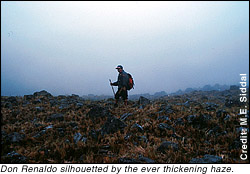
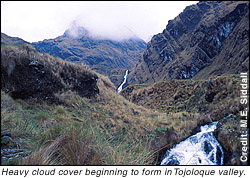
the time the clouds began to roll in and thicken around us I had more
than ten times as many leeches as had been collected in the previous five
days. But the haze was threatening to cut off our escape. Don Renaldo
was eyeing the greying air nervously. That made me nervous.
By
the time the clouds began to roll in and thicken around us I had more
than ten times as many leeches as had been collected in the previous five
days. But the haze was threatening to cut off our escape. Don Renaldo
was eyeing the greying air nervously. That made me nervous.
It was still before noon when we had to bug out of the valley—Don Renaldo was insistent and I wasn't going to argue. Fifteen minutes later, moving back up towards the pass, were it not for Don Renaldo's knowledge of what seemed like every boulder, ridge and gully, I'd have just plopped myself down for want of any sense of direction. Visibility was about 5 feet at best, but we made it back to the pass and out of the clouds without incident.
For the next two minutes we sat there ravenously consuming a can of fruit cocktail, pancito with peanut butter, cheese and the last of our water. By the time we had finished it was clear that we'd run out of time. Just below us the clouds were wisping up and over the outcroppings. We were too high up. It was now or never and I wasn't dressed for a night on a mountain top. Everything was hastily packed away and we started down. I was confused. Why was I out of breath? Downhill usually doesn't do that to me anymore. As my head cleared I realized we were running down the mountain! It was more like controlled high-speed stumbling. Was Don Renaldo serious? Running and leaping over steep loose shale? I was out of my league.
 We
came up to the old Incan Camino but instead of bearing right to follow
its gentle course, he flashed me a grin and headed straight over it, continuing
down the embankment headlong towards the base about 250 meters below!
Scared, I was hard on his heels, not willing to be left behind, nor relishing
the embarrassment of slowing our pace.
We
came up to the old Incan Camino but instead of bearing right to follow
its gentle course, he flashed me a grin and headed straight over it, continuing
down the embankment headlong towards the base about 250 meters below!
Scared, I was hard on his heels, not willing to be left behind, nor relishing
the embarrassment of slowing our pace.
Finally we hit bottom, both of us panting. Propped up against a huge boulder, Don Renaldo let out a huge laugh and a sigh of relief. We were out of danger, he said. There was a spring in my step as we swiftly descended Tojoloque to the camp. I had a ton of leeches, and had bettered my fears about trying to make the day's climb. It's time for dinner now. I've packed up all of my gear. It will be a 5.00 am wake up call. Have to make Quearra tomorrow, going back the way we came.
— Mark Siddall
| Also in this edition >>> |
Turtles in Trouble >>
The Conservation Education Network >> Viet Nam: Filling in the Gaps >> Of Gastropods and Bivalves >> Interpreting Biodiversity in Viet Nam >> The Beauty of Leeches >> Leech Prospecting in the Bolivian Andes >> |
|
Communicate
|
Contact the editor |
Contact the CBC |
| << Previous Article |
|
Resources
|
|
Email: siddall@amnh.org |
Newsletter Home & Archives |
Biodiversity Center Home | Center Programs | Publications | News & Events | Features| Museum Home