
 |
Fall 2000 |
Of Gastropods and Bivalves
The CBC's Third Invertebrate Identification
Workshop
 For
many people, knowing how to identify mussels and snails might come in
handy only in a fish shop or seafood restaurant. But for the hardy biologists
and naturalists who gathered at the CBC's third annual Invertebrate Identification
Workshop, this knowledge can be used to help conserve these ecologically
important species and the ecosystems they inhabit.
For
many people, knowing how to identify mussels and snails might come in
handy only in a fish shop or seafood restaurant. But for the hardy biologists
and naturalists who gathered at the CBC's third annual Invertebrate Identification
Workshop, this knowledge can be used to help conserve these ecologically
important species and the ecosystems they inhabit.
This year's two-day workshop focused on freshwater mollusks (mussels and snails) of the eastern United States. (Unlike the popular marine mussel, you won't find freshwater varieties on any local menu. In fact, taking one of the several endangered species could land you in the soup.) In attendance were professional biologists, naturalists, resource managers, consultants, teachers, and others—all responsible (directly or indirectly) for the conservation and management of much of our region's biodiversity.
 Day
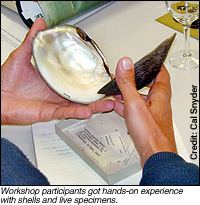
One took place in a laboratory classroom on the Museum's sixth floor,
where instructors David L. Strayer, a freshwater ecologist with the Institute
of Ecosystem Studies, and James Cordeiro, collections manager in the Museum's
Division of Invertebrate Zoology, took a tag-team approach to describing
the anatomy, diagnostic parts, and life history of bivalves (mussels)
and gastropods (snails). Shells and live animals were made available for
comparison, and Cordeiro opened the Museum's exhaustive mollusk collection
to inspection.
Day
One took place in a laboratory classroom on the Museum's sixth floor,
where instructors David L. Strayer, a freshwater ecologist with the Institute
of Ecosystem Studies, and James Cordeiro, collections manager in the Museum's
Division of Invertebrate Zoology, took a tag-team approach to describing
the anatomy, diagnostic parts, and life history of bivalves (mussels)
and gastropods (snails). Shells and live animals were made available for
comparison, and Cordeiro opened the Museum's exhaustive mollusk collection
to inspection.
Strayer, who literally wrote the book on Unionids, the pearly mussels (he is coauthor, with Kurt J. Jirka, of The Pearly Mussels of New York State), described the plight of this diverse but highly imperiled group of animals. Of the 300 species in North America (with some 50 in New York State), three-quarters are threatened with extinction, according to The Nature Conservancy. Another group, Sphaeridae (fingernail clams), is quite varietous, with 37 species in North America, 32 in New York State. There are 15 families of freshwater snails (prosobranchs and pulmonates) in the United States, 10 of which are found in New York; fully 50 percent are imperiled.
Mussels and snails are endangered by the alteration of their habitats by dams, channels, and other water diverters that can lock out the fish hosts on which mussel larvae depend, by overharvesting (some 13 million pounds of mussels are collected each year to make buttons), by pollution, exotic species, and climate change. Snails face additional peril from shoreline alterations, including the aesthetic removal of rooted plants, which are a primary habitat.
The infamous zebra mussel (Dreissenidae sp.) and the Asiatic clam (Corbicula sp.) are non-native, invasive species, and pose a serious threat to their native cousins. In the larval stage of development, native mussels attach to the gills or fins of a host fish to complete their metamorphosis. Zebras skip the larval stage. While the females of both native and exotic species produce several thousand eggs in a year, the invading zebra grows faster than the locals, and its survival is not dependent on the presence of another species. Once they have muscled their way in to an area, zebras gobble up the microscopic organisms that form the foundation of the freshwater food chain. In the Hudson River, their arrival precipitated an 85-percent drop in phytoplankton, and a 90-percent drop in zooplankton, according to Strayer.
 Just
how important a role do these spineless critters play in the health of
freshwater ecosystems? Both gastropods and bivalves are good water-quality
indicators, providing an early warning system of water-quality degradation.
Filter-feeding mussels graze on phytoplankton and other particles in the
water column, and snails are both herbivores, feeding on algae and macrophytes
(aquatic plants), and detrivores, cleaning up dead matter. Between them,
they provide a rich food source for fish, leeches, crayfish, diving ducks,
raccoons, otters, and muskrats. Protecting these animals is a complicated
endeavor, given the complex web of relationships they inhabit. A good
first step is understanding each species's abundance, distribution, and
status in a given watershed.
Just
how important a role do these spineless critters play in the health of
freshwater ecosystems? Both gastropods and bivalves are good water-quality
indicators, providing an early warning system of water-quality degradation.
Filter-feeding mussels graze on phytoplankton and other particles in the
water column, and snails are both herbivores, feeding on algae and macrophytes
(aquatic plants), and detrivores, cleaning up dead matter. Between them,
they provide a rich food source for fish, leeches, crayfish, diving ducks,
raccoons, otters, and muskrats. Protecting these animals is a complicated
endeavor, given the complex web of relationships they inhabit. A good
first step is understanding each species's abundance, distribution, and
status in a given watershed.
Subtle peculiarities help tell one species of mussel or snail from another: the short inflated orange foot of Anodonta netarodon and the bi-color nacre of the boxy Strophylus (both mussels), or the Bithynii's calcareous operculum (a kind of trap door to the shell) and the sinestral (counter-clockwise) shell whorl of the Physidae (both snails). With a good grounding in the diagnostic features of both groups, our intrepid workshoppers moved out of the lab and into the field on Day Two.
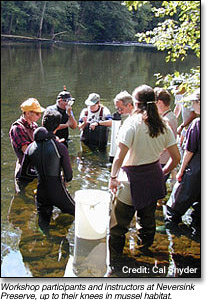
Dressed in an assortment of hip-boots, chest waders, and wetsuits, participants explored two freshwater field sites near Port Jervis, NY. The morning was spent at The Nature Conservancy's Neversink Preserve, where the rocky-bottomed riverbed provides fertile ground for mussels. With heads inserted in Plexiglas-bottomed buckets, participants made their way upriver, locating specimens and gathering to discuss probable identifications. Spent shells were also sought out, enabling close examination of both interior and outer shell without sacrificing an animal. Strayer outlined proper methods for surveying, recommendations on where to send voucher specimens, the importance of accurate note-taking to record locality information, water quality conditions, and the like.
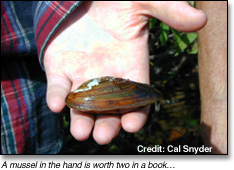
One wet-suited participant, Bill Lellis, a research physiologist with the US Geologic Survey's Biological Resources Division, in Wellsboro, Pennsylvania, described a method he discovered for non-invasive identification: drop a mussel in deep water and watch its pattern of descent. He observed that Elliptio complanata's somewhat flattened shell makes a wide spiral, while teardrop-shaped Alasmidonta undulata drops almost straight to the bottom in a tight corkscrew spiral, and the uniformly thin Strophitus undulatus flutters slowly to the bottom sideways. (Ultimately, it is a combination of siphon structure, feel, shape, beak sculpturing, color, behavior, and habitat that lead to a final identification.)
 Snails
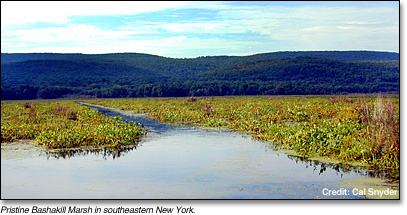
were the focus at a second site, the pristine Bashakill Marsh. Cordeiro
demonstrated the use of a blunt mussel rake to scoop up plant material
frequented by the gastropods, and gave a brief presentation on preserving
collected specimens—alcohol preservation is necessary for DNA analysis,
but formalin-fixed animals are easier to dissect. There were also some
handy tips on sealing leaky waders (bathtub caulk got a thumb's up) and
constructing one's own glass-bottom bucket.
Snails
were the focus at a second site, the pristine Bashakill Marsh. Cordeiro
demonstrated the use of a blunt mussel rake to scoop up plant material
frequented by the gastropods, and gave a brief presentation on preserving
collected specimens—alcohol preservation is necessary for DNA analysis,
but formalin-fixed animals are easier to dissect. There were also some
handy tips on sealing leaky waders (bathtub caulk got a thumb's up) and
constructing one's own glass-bottom bucket.
After two fact-filled and enjoyable days, each conservation professional had improved his or her skills at identification, surveying, and monitoring freshwater mussels and snails, as well as improving their understanding of the complex ecosystems they are working to protect or restore.
—
Fiona Brady
| Also in this edition >>> |
Turtles in Trouble >>
The Conservation Education Network >> Viet Nam: Filling in the Gaps >> Of Gastropods and Bivalves >> Interpreting Biodiversity in Viet Nam >> The Beauty of Leeches >> Leech Prospecting in the Bolivian Andes >> |
|
Communicate
|
Contact the editor |
Contact the CBC |
| << Prev. Article | Next Article >> |
|
Resources
|
|
Institute of Ecosystems Studies DAVID
L. STRAYER Institute of Ecosystem Studies |
|
AMNH Division of Invertebrate Zoology James
Cordeiro |
| Newsletter
Home & Archives |
Biodiversity Center Home | Center Programs | Publications | News & Events | Features| Museum Home